
Why Tiered, Classical, and Architectural Fountains So Often Become Maintenance Nightmares in Minnesota
The fountain had been sitting silent for three years by the time we got the call.
It was a three-tiered, formal concrete fountain, the kind you picture in a European courtyard. Elegant, symmetrical, and timeless. The homeowners loved the look, which is why they kept trying to make it work. Over those three years, they had hired FIVE different landscape, plumbing, and irrigation companies to fix it. Every attempt ended the same way. It leaked.The water never flowed evenly. Eventually, after the second year they shut it off entirely.
By the time we met them, they were exhausted. (And to be transparent, our experience with the project was difficult too.) We told them upfront that we could not offer any kind of warranty on anything concrete in Minnesota. We explained that these fountains fight our climate at every level. We even offered alternative fountain options that would have been much cheaper to install, easier to maintain, and far more reliable long-term. But they wanted the classic tiered look. They also did not want our modifications done to the fountain that we normally do on these kinds of fountains, as they wanted to keep the original manufacturer’s warranty valid.
While we are professional consultants, at the end of the day we will execute the client’s vision. So we proceeded carefully, knowing what we were getting into.
We disassembled and reassembled that fountain four separate times. Each time was driven by new requests after the fact. Adding lights. Adding an automatic water filler. Changing the pump. With modern fountains, those upgrades are straightforward. With tiered concrete fountains, every change required major modification. These systems are not modular. They are not customizable. They were never designed to evolve. Ideally, they are set up once and never touched again except for cleaning. They were never designed to be adjusted after the fact.
The following winter, the concrete base shifted just enough from freeze and thaw cycles that the water no longer flowed evenly. The seal at the very bottom failed again. The fountain needed to be drained, resealed, and leveled once more. This time the client approved our modifications to the seal which allowed us to set things up to be more one and done and prevent the need to disassemble the fountain for replacing the pump or lights at any point.
Since then, there have been no more callbacks for leaking seals again. This water fountain, over the span of 4 years, cost the owners just under $80,000.
While this is the worst case we’ve ever experienced, this story is not unique. It is one of the clearest examples of why certain popular fountain styles consistently become high-maintenance / high-cost headaches in Minnesota.
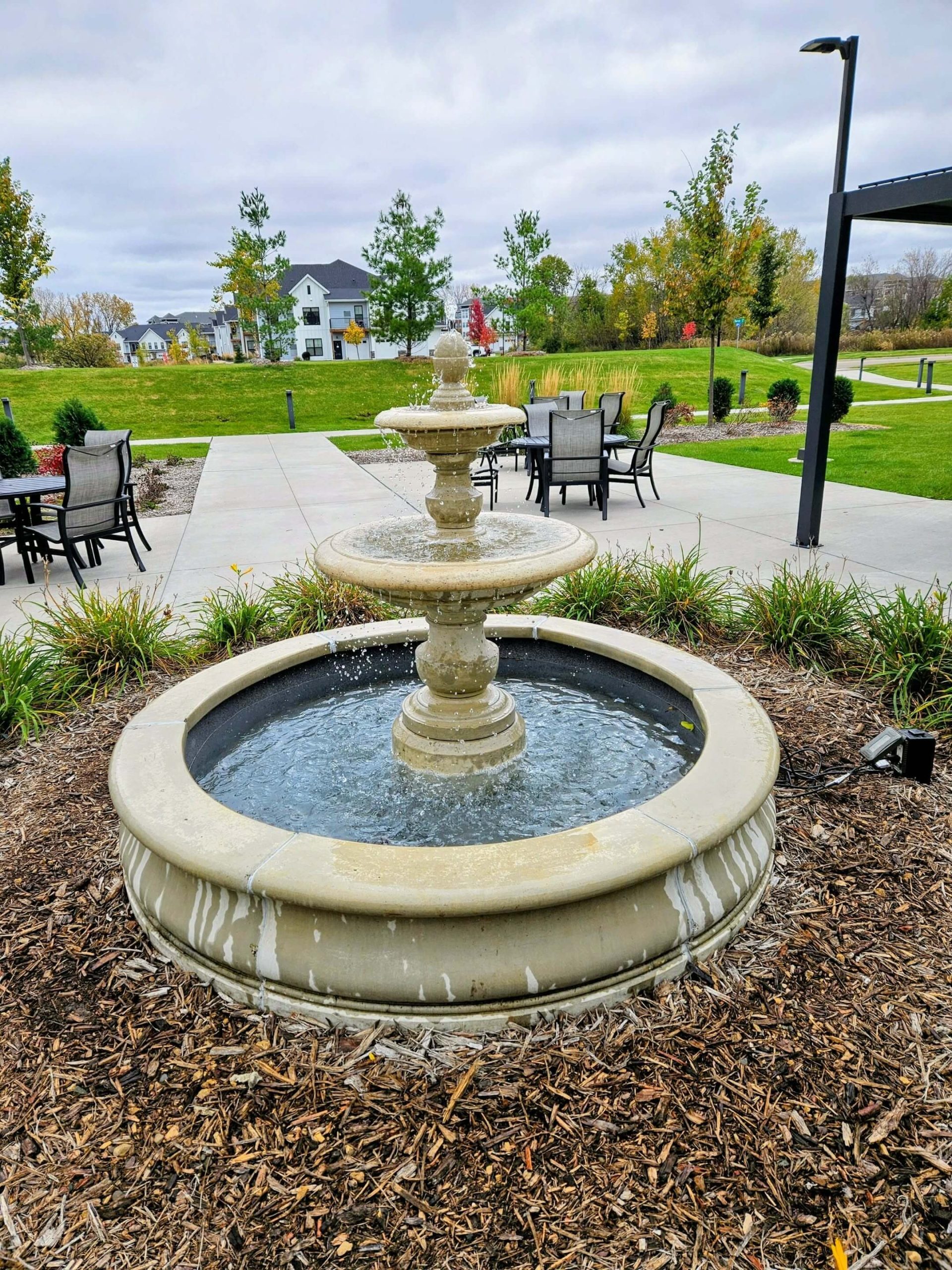
Why These Fountains Are So Much Harder Than They Look
They Are Extremely Heavy and Inflexible
These fountains are mostly built from cast concrete or stone composites (sometimes even marble). Individual pieces can weigh hundreds of pounds. Moving them into place often requires heavy equipment, or half a dozen technicians to manually set individual pieces into place. Once installed, these fountains cannot flex, shift, or adapt without compromising the seals and water flow.
Minnesota soil moves. Freeze and thaw cycles cause expansion and contraction every year. According to the Minnesota Department of Natural Resources, frost depth regularly exceeds four feet in many parts of the state. That movement is enough to crack seals, shift bowls, and tilt stacked components.
Unlike ecosystem fountains or modern modular systems, tiered fountains have no tolerance for movement. When the ground shifts, something breaks. This is the idea behind stress lines in concrete in driveways and sidewalks, so that you can guide the cracks when they happen. Unfortunately for water fountains (unlike concrete driveways and sidewalks), cracks anywhere mean it’s leaking.
They Require a Concrete Base, Not Soil or Gravel
To attempt long-term stability, these fountains really should be installed on a poured concrete pad. That adds time, cost, and complexity. The pad must cure. The fountain must be assembled on top of it. Sealants must cure again. Any mistake in leveling is magnified as water cascades down multiple tiers.
Even with a proper base, movement still happens. Concrete does not prevent frost movement. It simply moves as one rigid mass.Typically this is enough to keep the water fountain operating correctly, as long as the pad is installed correctly. Additionally, there’s a couple modifications we recommend to make access possible after installation. While this voids the manufacturers warranty in most cases, it’s the difference between a fountain that can take additional features in the future (lights, replacement pump, automatic water fill valve) vs a fountain that can’t without being disassembled. From our experience, clients are much happier with our modifications because it ensures a system that operates more reliably.
While a combination of gravel and sand can work for the base, we’ve seen gravel pads alone shift too often to be reliable. However, for some homeowners trying to keep costs down and trim project timelines, a gravel base done well can still keep a water fountain in upright condition with some slight shimming occasionally as the ground shifts. For some, this is not a big matter and the cost savings seal the deal.
No Filtration Means Constant Manual Cleaning
This is one of the biggest misunderstandings. DIYers oftentimes don’t realize this until after they put their fountain together and realize all the gunk that builds up every month. Tiered and classical fountains have no filtration. None.
There is no biological filter. No mechanical pre-filter. No ecosystem balance. That means debris, dust, pollen, algae, bird droppings, and organic matter all stay in the water unless manually drained out.
The result is predictable.
Homeowners or one of our maintenance teams must manually clean these fountains frequently. In Minnesota, monthly cleanings are common during the water feature season. Many require chemical treatments to keep water visually clear. Without circulation through biological media and mechanical filtration, water quality relies almost entirely on human intervention.
In contrast, ecosystem-based fountains cycle water through gravel and biological surfaces where beneficial bacteria break down waste naturally. Tiered fountains skip that entirely. More chemicals. More cleaning. More maintenance. More frustration.
Why These Fountains Fall Apart So Quickly Here
Most people are surprised to learn that many tiered fountains can be relatively inexpensive to purchase. Small setups can be purchased as low as a few hundred dollars, while other off-brand fountains can be picked up for as little as a couple thousand. Unless a quality tiered decorative water fountain is being purchased which can range from $8,000-$50,000, the real cost typically comes later.
Concrete is porous. Water seeps into the surface. When temperatures drop, that water expands. Over time, the surface begins to flake, crack, and crumble. Often this happens by the second winter if water is left inside.
We routinely see bowls crack, lips crumble, and structural integrity fail. Replacement parts are expensive, if they are available at all. In many cases, the entire fountain must be replaced.
The University of Minnesota Extension documents how freeze and thaw cycles accelerate concrete deterioration when moisture is present. Add constant water exposure, and the lifespan shortens dramatically.
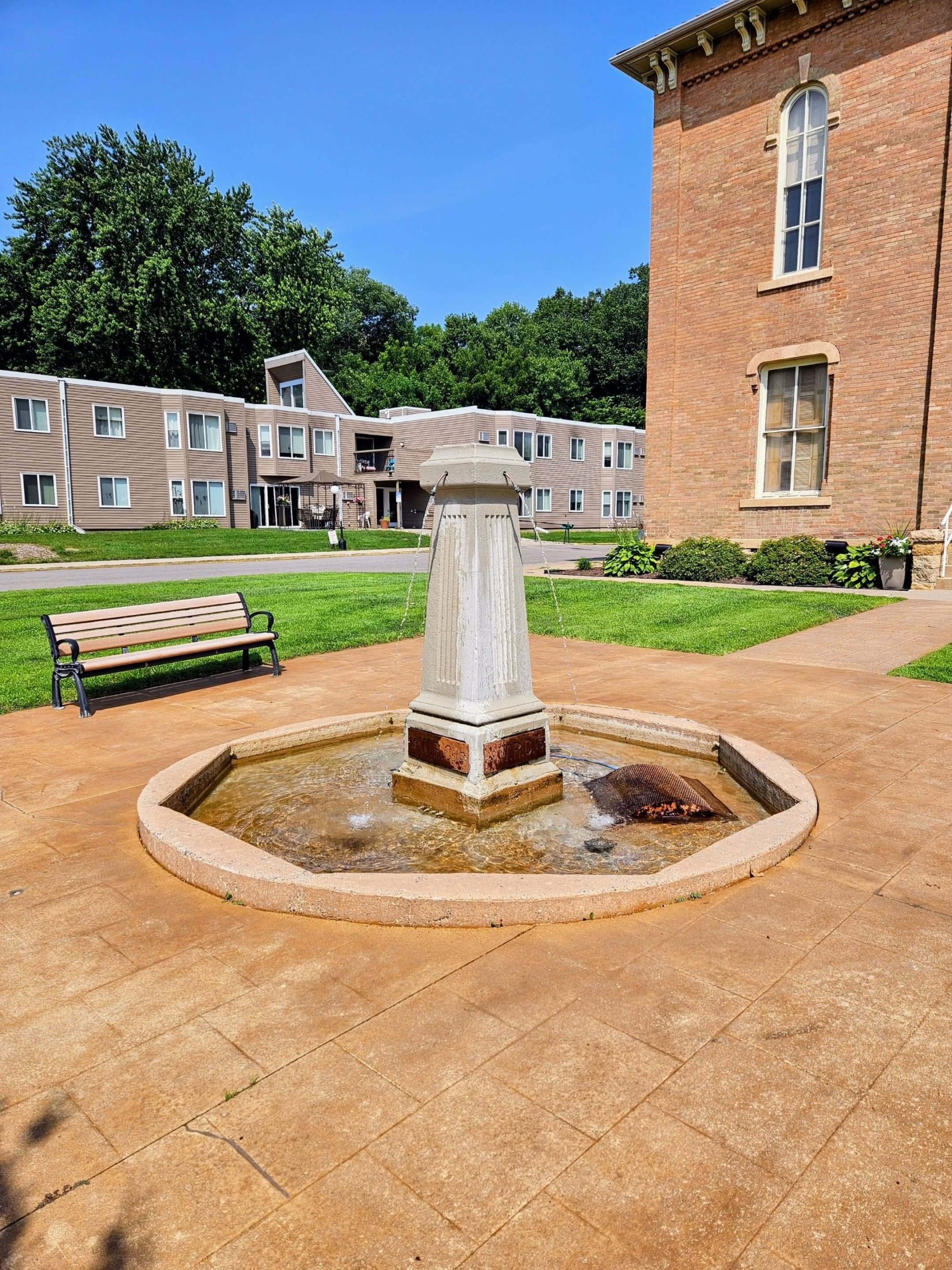
The Design Flaw Nobody Questions
Here is the question we ask homeowners all the time: Why is there a hole in the bottom of the fountain?
Nearly all tiered and architectural fountains route plumbing and electrical through the center base of the fountain. That means water pressure, vibration, and movement are all concentrated at the lowest point. This is the worst possible location for a penetration if your goal is to prevent leaks (imagine your morning cereal bowl having a hole in the bottom that needs to be plugged before filling with milk).
To improve reliability, we often modify these fountains to operate more like our pond equipment. We adapt the undersides to accept bulkhead-style fittings similar to skimmers and BioFalls. We sandwich the parts together and then add an extension to place the penetration hole above the waterline. While this voids the manufacturers warranty, it creates a water fountain that actually works. These connections hold better and are easier to maintain.
Even with modifications, the fundamental design is still working against us.
Why These Fountains Became Popular in the First Place
So why do these fountains exist at all if they perform so poorly here?
The answer is climate.
Tiered and classical fountains originated in Italy and the Mediterranean. These regions have temperate weather, minimal freeze cycles, stable soils, and abundant natural springs. In many historic installations, fountains are supplied by constant fresh water flowing through stone or limestone basins. They are not sealed vessels fighting the same kind of groundwater and frost.
Those fountains are part of a larger hydrological system. They are not standalone water features.
Taking a design meant for a warm, spring-fed environment and installing it in soggy Minnesota is not a fair comparison. The same fountain behaves completely differently.
What works beautifully in Rome does not translate to Minneapolis.
The Real Cost of Owning One of These Fountains
Here is the part most contractors avoid discussing.
Working on tiered and architectural fountains costs, on average, two to three times more than working on a modern fountain system. Not because the work is better, but because it is harder, slower, and more fragile. An $8,000 water fountain (everything included) in our regular style is going to be starting at $12,000 for a classical tiered concrete fountain (not including the fountain itself).
Costs typically include:
- Concrete base preparation and curing
- Multiple assembly and disassembly stages
- Specialty sealants and extended cure times
- Protection from rain and water while sealants are curing
- Seasonal draining and winter prep
- Frequent cleanings and chemical treatments
- Eventual repair or replacement of cracked components
Many homeowners literally laugh at pricing when we present it. Then we hear back two or three years later when the fountain still does not hold water, or a tier has crumbled and needs replacement. We’re not trying to overcharge, it’s just that much of a headache in most cases. Our teams typically don’t even like working on these fountains because they don’t like doing things twice, which is often what happens with these projects. Cheap to buy does not mean cheap to own.
And if you have any special calendar deadlines to meet with a classical decorative fountain like this, throw it out the window because these setups have a mind of their own. Right when you think it’s finished, something is leaking and needs to be adjusted again.
Why Most Contractors Struggle With These Fountains
These fountains sit at an awkward intersection between masonry, plumbing,electrical, irrigation, and water feature design. Most landscape contractors do not specialize in any of those at a deep level. Plumbers understand water pressure, but not outdoor biological systems. Masons understand stone, but not circulating water.
We focus exclusively on water features. That means we understand how all these systems interact. Even with that being said, we’re not masons, plumbers, electricians, or irrigators. It’s not uncommon for other experts to be needed onsite to finish one of these fountain setups properly.
What Makes Superior Ponds Different
We do not sugarcoat these projects. They are not fun until we’re gone and you can finally enjoy the beautiful water fountain.
We explain upfront that tiered and classical fountains:
- Require frequent maintenance
- Cannot be warranted in Minnesota conditions
- Cost more to install and maintain long-term
- Will need repairs over time
We also offer alternatives that deliver water elegance with far less risk. Modern fountains with hidden reservoirs, proper filtration, and flexible plumbing adapt to soil movement and winter conditions. They are easier to customize. They are easier to service. They simply work better here.
Sometimes clients still choose the classical fountain. When they do, we support them honestly, with eyes wide open understanding the risks. Our ask is that you let us do things our way.
Key Takeaways for Homeowners
Tiered and architectural fountains are beautiful, but beauty does not equal reliability. In Minnesota, these fountains fight our climate, soil movement, and freeze cycles every year.
They lack filtration, require constant cleaning, rely on chemicals, and often deteriorate quickly. Their origins in warm, spring-fed environments do not translate to northern conditions.
Understanding this before you install one can save years of frustration and thousands of dollars.
How Superior Ponds Can Help
At Superior Ponds, we specialize exclusively in water features. We take a maintenance-first approach and design systems that thrive in Minnesota’s climate. Whether you are restoring a classic fountain, considering alternatives, or planning something entirely new, we believe in honest conversations and long-term solutions. Schedule a call with us today!
Because the goal is not just a beautiful water feature. The goal is peace.
“Connecting people to water.”